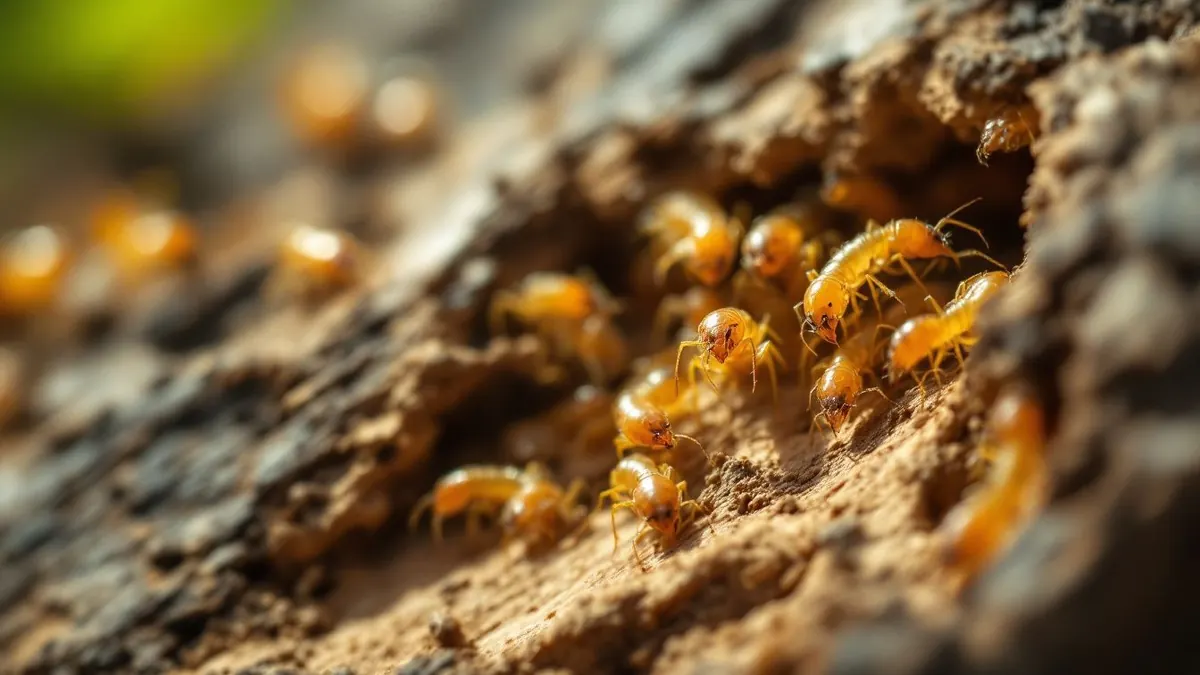
Subterranean termites cause most termite damage in the U.S. They nest in the soil, travel to wood through mud tubes and can be found in nearly every state except Alaska. Formosan termites are a subterranean species with especially large, aggressive colonies, established in the Gulf Coast, the Southeast, Hawaii and parts of California.
How subterranean termites live
Colonies live underground and need moisture. Workers forage outward — sometimes far from the nest — and build mud tubes over foundations and other surfaces to reach wood while staying protected from dry air and light. Inside the wood they leave tunnels packed with soil.
Signs of subterranean termites
- Mud tubes on foundation walls, piers, pipes or inside walls — see termite mud tubes
- Swarmers in spring, often after rain, or discarded wings — see termite swarmers
- Damaged wood with soil-packed galleries following the grain
- Moisture problems near the foundation, which attract them
Formosan termites
| Native subterranean | Formosan | |
|---|---|---|
| Colony size | Large | Very large — often millions |
| Swarmers | Dark, daytime in spring | Yellowish-brown, evenings near lights, late spring–summer |
| Nests | In soil | In soil, and sometimes above-ground "carton" nests in walls |
| Damage speed | Steady | Faster due to colony size |
How pros treat subterranean termites
- Liquid termiticide barrier: soil around the foundation is treated so foraging termites contact the product. Non-repellent products are carried back through the colony.
- Bait stations: stations in the ground with a slow-acting bait that workers share, eliminating the colony over time; monitored on a regular schedule.
- Combination: common for Formosan termites.
Cost
Liquid treatment typically runs $3–$16 per linear foot of foundation and bait systems $7–$12 per linear foot plus monitoring, per 2026 cost guides. Full breakdown: termite treatment cost.
Prevention
- Fix leaks and keep gutters and downspouts draining away from the house.
- Keep mulch, soil and firewood away from siding and wood framing.
- Avoid wood-to-soil contact on decks, steps and fences.
- Ventilate crawl spaces and consider a vapor barrier.
- Schedule annual inspections in moderate- and high-risk states — see termite inspection.
Frequently asked questions
How far do subterranean termites travel?
Foraging workers can travel a considerable distance through soil from the nest, which is why treatment focuses on the soil around the whole structure.
Can subterranean termites live without soil?
They need moisture. Formosan termites can sometimes nest above ground where there's a constant moisture source, such as a roof leak.
Do bait stations work as well as liquid treatment?
Both are effective when installed and maintained correctly. Liquid barriers act faster; baits target the colony over time and require ongoing monitoring.