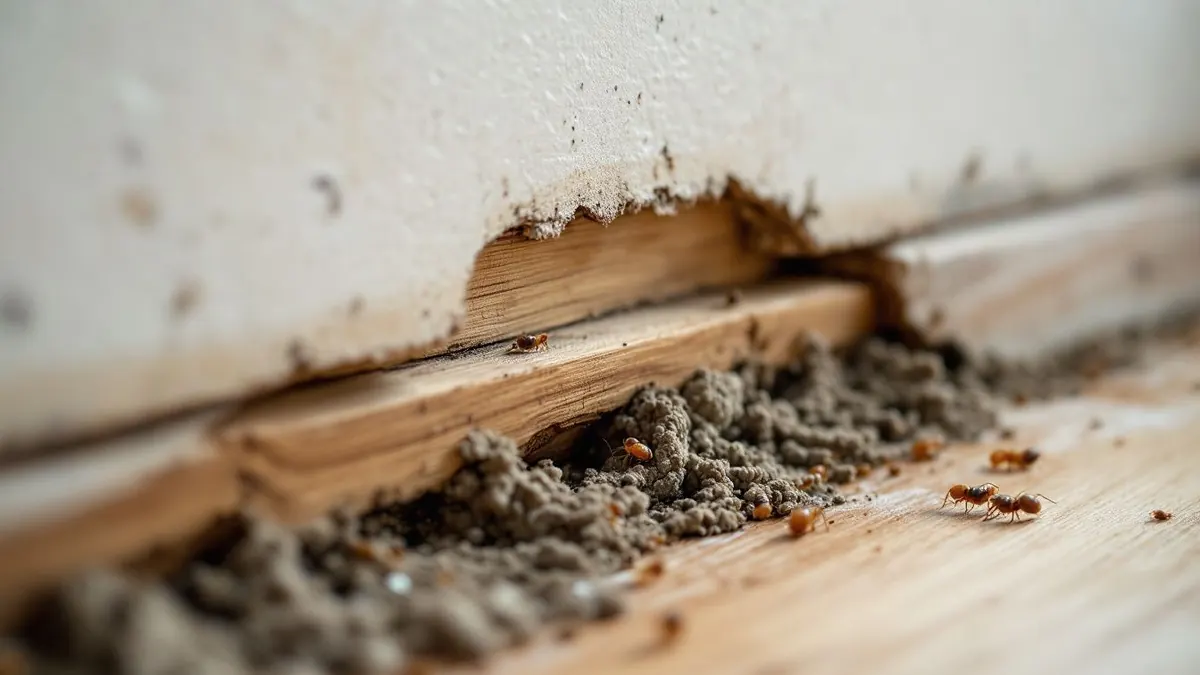
Drywood termites live entirely inside the wood they eat. They don't need contact with soil, so they can infest attic framing, window frames, furniture and trim anywhere in the house. In the U.S. they're mainly a problem in warm coastal areas: Florida, Southern California, Arizona, Hawaii and along the Gulf Coast.
Signs of drywood termites
- Piles of pellets (frass) below wood — tiny, six-sided, sand-like. See termite droppings.
- Kick-out holes: tiny round holes in wood surfaces where pellets are pushed out.
- Swarmers at dusk or night, often in late summer or fall, attracted to lights.
- Blistered paint or hollow wood in trim, frames, furniture or attic beams.
Drywood vs subterranean termites
| Drywood | Subterranean | |
|---|---|---|
| Lives in | Wood only | Soil, travels to wood |
| Mud tubes | No | Yes |
| Droppings | Visible pellets | Rarely visible |
| Colony size | Smaller (often thousands) | Larger (hundreds of thousands+) |
| Typical treatment | Spot treatment, heat, fumigation | Liquid barrier, baits |
More on the other type: subterranean termites.
Treatment options
- Spot / localized treatment: injecting termiticide or foam into galleries in accessible wood. Works for small, well-defined infestations.
- Heat treatment: heating the structure or part of it until the wood core reaches a lethal temperature. No chemicals; shorter time out of the home.
- Fumigation (tenting): the whole structure is sealed and fumigated — the most complete option for widespread infestations. See termite tenting.
- Wood replacement: removing infested pieces when the infestation is limited.
Drywood termites are often in several separate spots, so a thorough inspection is key before choosing a localized method.
Cost
Spot treatments are typically the least expensive; heat treatment costs roughly $1–$2.50 per square foot; and fumigation about $1–$4 per square foot according to 2026 cost guides. Details in our termite treatment cost guide.
Frequently asked questions
Can drywood termites spread to furniture?
Yes. They can infest wooden furniture, and infested furniture can carry them into a home. Inspect used wooden furniture in warm regions.
Do drywood termites live in northern states?
They're uncommon outside warm coastal regions, though they can arrive in infested wood or furniture.
Does orange oil work on drywood termites?
Orange oil (d-limonene) is used as a localized treatment injected into galleries. It only affects the termites it reaches, so it's suited to small, accessible infestations.