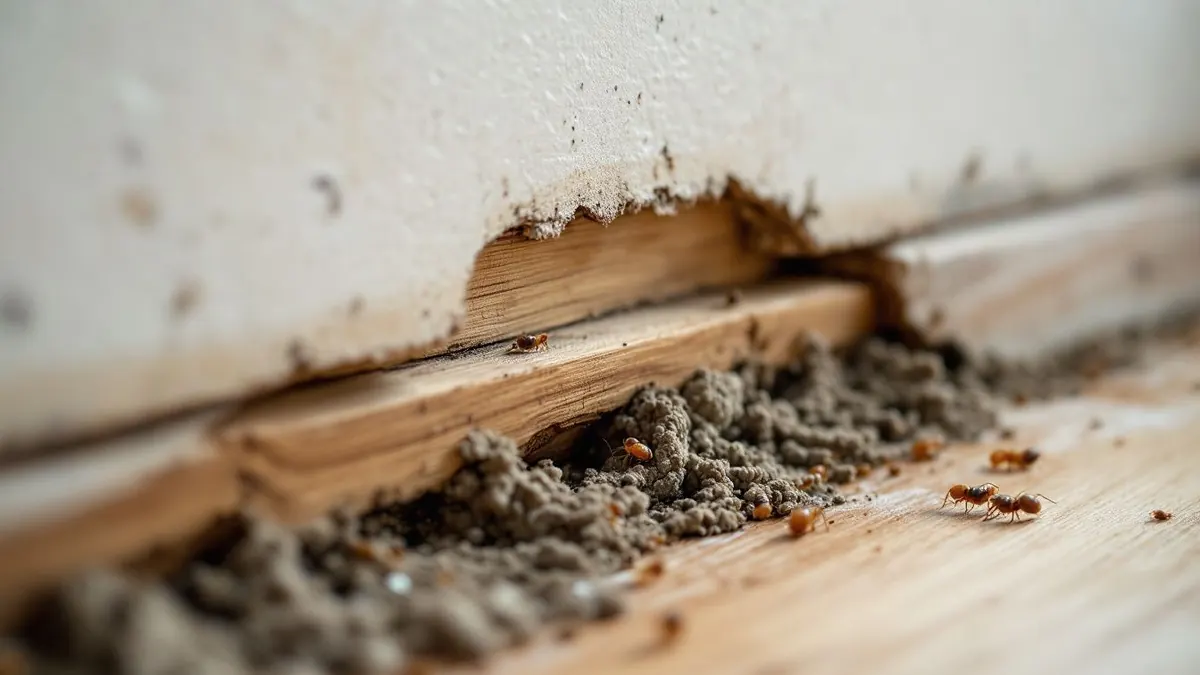
Finding small piles of what looks like sand, sawdust or coffee grounds near wood trim or furniture? It may be termite frass — the droppings of drywood termites. It's one of the clearest signs that termites are living inside the wood above it.
What termite droppings look like
- Tiny pellets, about 1 mm long — like coarse sand or poppy seeds
- Six-sided, ridged shape under a magnifying glass
- Color that matches the wood being eaten: light tan to reddish-brown to almost black
- Small piles below a wood surface, often beneath tiny "kick-out" holes
- Piles that come back after you sweep them up
Drywood termites push droppings out of their galleries through these small holes to keep their tunnels clean, which is why the pellets collect in mounds on windowsills, floors or in drawers.
Which termites leave visible droppings?
| Termite | Visible droppings? |
|---|---|
| Drywood | Yes — piles of hard pellets |
| Subterranean (including Formosan) | Rarely; they use droppings and soil to build mud tubes |
| Dampwood | Sometimes, larger pellets in very wet wood |
If you don't see pellets but find mud tubes on the foundation, you're more likely dealing with subterranean termites. Read about subterranean termites and drywood termites.
Termite frass vs look-alikes
- Sawdust from carpenter ants: fibrous shavings mixed with insect parts, not uniform pellets.
- Carpenter bee debris: coarse sawdust below perfectly round holes in exposed wood.
- Mouse droppings: much larger (about ¼ inch) and rod-shaped. See mouse droppings.
- Roach droppings: pepper-like specks or smears near food areas.
What to do if you find termite droppings
- Take a photo and save a sample in a sealed bag for identification.
- Sweep it up and check back in a few days. New pellets mean active termites.
- Look up: inspect the wood directly above for tiny holes or blisters.
- Get an inspection. Drywood termites can be in several areas of the home at once. Treatment ranges from spot treatment to whole-structure heat or fumigation — see termite tenting.
Frequently asked questions
Are termite droppings harmful?
Frass isn't considered toxic, but it can irritate allergies. The bigger issue is what it signals: active termites eating the wood.
Can I just vacuum termite droppings?
Yes, you can clean them up — but note where they came from first, and watch for new piles. Cleaning doesn't affect the colony.
Do termite droppings mean the infestation is old?
Not necessarily. Fresh pellets reappearing after cleaning indicate current activity; old piles with no new pellets may point to a past infestation.